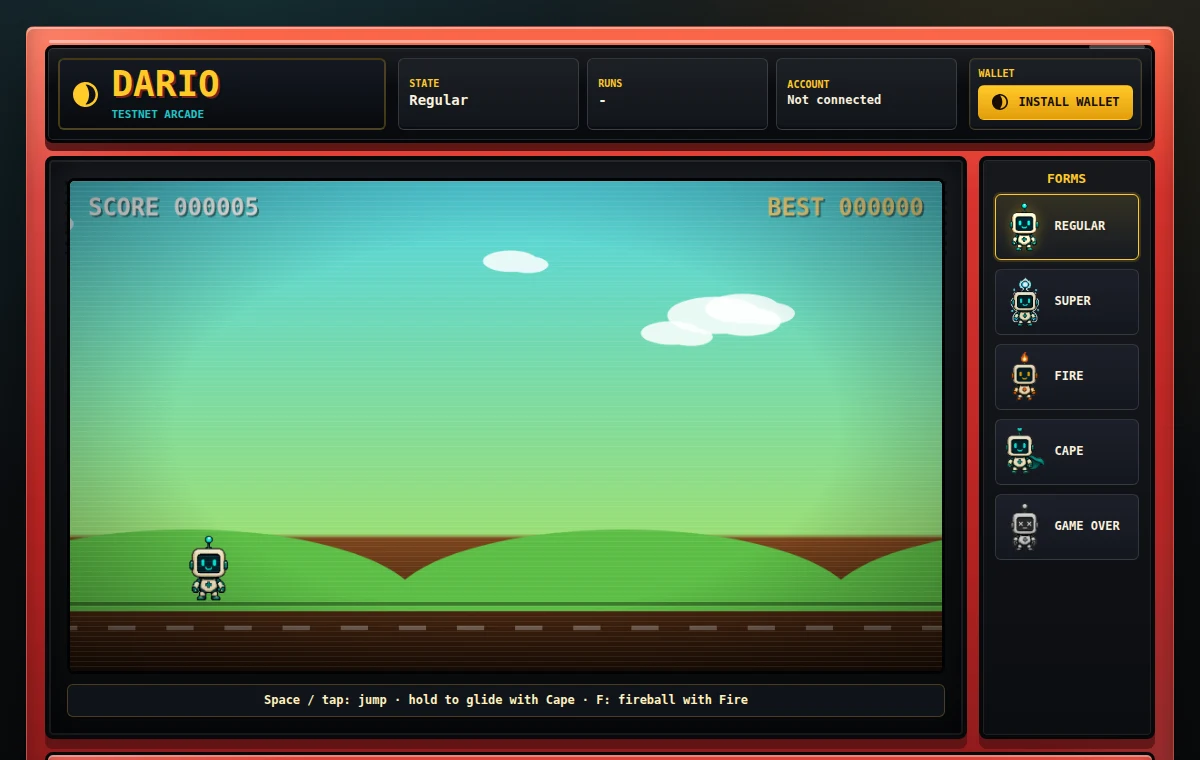
A score is a claim
In a browser game, the player controls the machine reporting the score. Posting a number to a leaderboard proves nothing about how it was produced.
Dario backs that number with a proof. Its circuit constrains movement, collisions, obstacle clearance, power-ups, damage and scoring. The contract checks the proof before accepting a ranked score.
From a run to a verified result
- Play locally. The deterministic Rust simulation runs as WebAssembly and records the inputs and witness data for the run.
- Prove in the browser. A Web Worker uses Circom-generated artifacts and snarkjs to produce a Groth16 proof. The input trace stays client-side.
- Verify on-chain. The Dusk contract reconstructs the seeded obstacle schedule, binds the transaction sender into the public inputs and verifies the proof. It also rejects seed replays.
The repository also has a native RISC Zero proving path; the browser demo uses the Circom/snarkjs path.
What it proves and what it does not
The proof shows that a run followed the game's encoded rules. It does not prove a human played it: a bot-generated input sequence that obeys the rules still produces a valid proof. So this is not a general anti-cheat or proof-of-humanity check.
You still trust the circuit and contract code. The repository ships contract tests with checked-in proofs, not an independent security audit.
The cost of keeping proving local
The browser path downloads a ~200 MB proving key (cached after the first run). Proof generation takes roughly 10 to 60 seconds depending on the machine.
Ordinary play needs no wallet; submitting a ranked run adds the proving step and a Testnet transaction.
Source: the Dario README and contract implementation. This is a playable experiment, not a production gaming service.